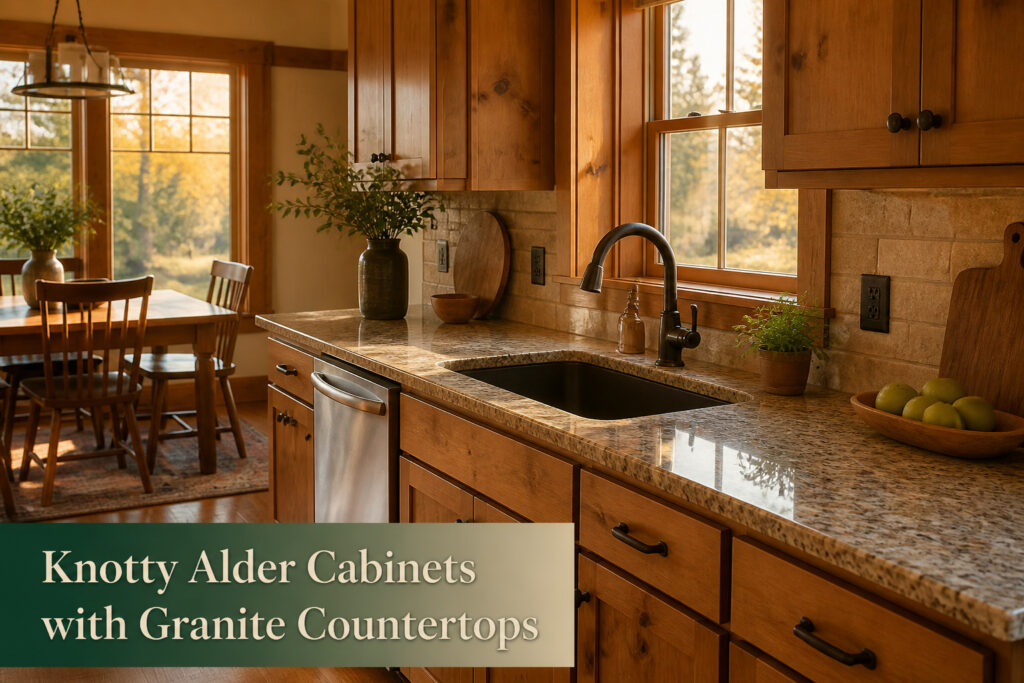
Knotty alder cabinets with granite countertops pair a soft, rustic North American hardwood with dense stone that can take daily kitchen wear.
The catch is the wood itself: at 590 on the Janka scale, alder dents and scratches far easier than maple or oak, so the finish matters less for prevention than for hiding what happens.
Custom runs run $302 to $371 per linear foot, a gap below cherry that often covers the granite upgrade.
Knotty Alder Characteristics
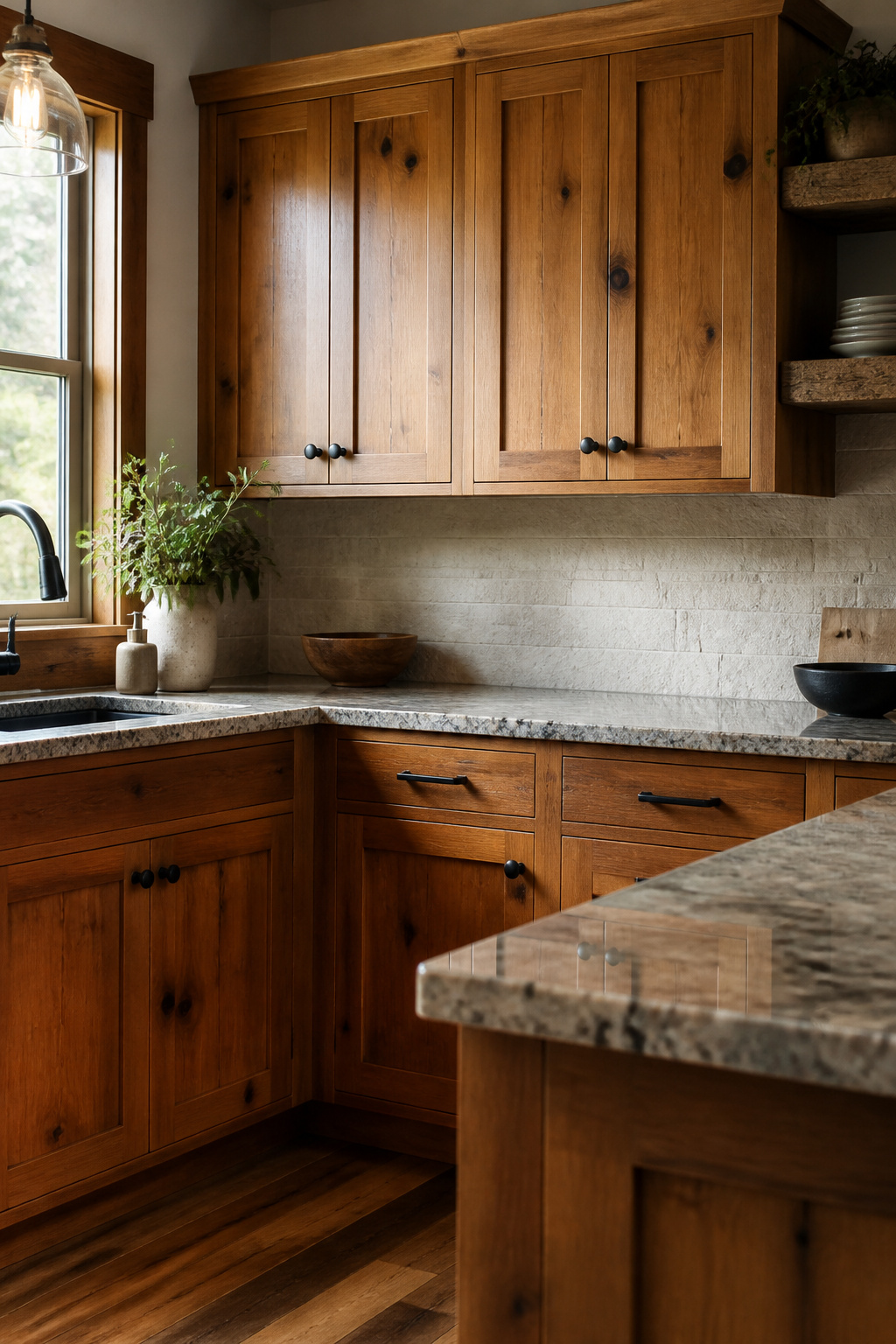
Knotty alder looks like someone left the forest alone and built cabinets straight from what grew there.
Open knots, mineral streaks, and grain that shifts from board to board give each door its own face; no two match, which is exactly the point.
The tone runs warm honey to reddish-brown when new, and the wood carries natural wormholes alongside those knots for a texture that reads rustic without trying hard.
The softness matters in daily use. Alder sits at 590 on the Janka hardness scale, well below maple or oak, so dents and scratches arrive easier than on harder species.
That same softness makes the wood easier to machine and finish, which keeps fabrication costs in check and lets stains settle evenly into the grain.
Material is sourced in North America, so supply lines stay short and lead times tend to run predictable.
One shift to plan for: sun exposure lightens the color over time. The warm honey-brown you install will mellow paler across the years, especially on cabinet faces catching morning kitchen light.
The change is gradual, but it moves in one direction, and the finish you choose won’t fully stop it.
Recommended Products

SPACE-SAVING DESIGN: Wall-mounted ironing board cabinet that folds out when needed and neatly conceals the board behind an attractive natural wood door when not in use

Premium Solid Maple Wood: Crafted from 100% solid maple for lasting durability. Smooth-sanded and splinter-free, ideal for painting, staining, or sealing. The perfect upgrade for high-end cabinet refacing or DIY projects
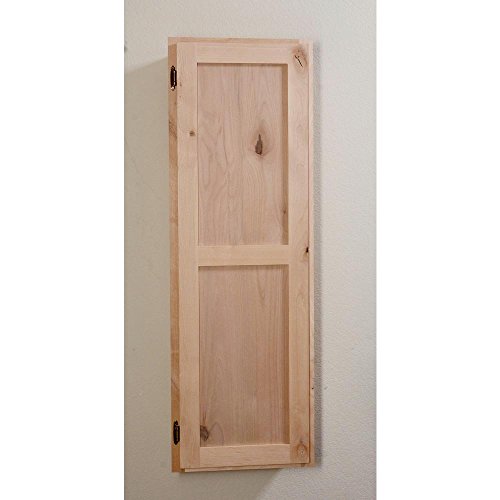
CORRECT DIMENSIONS 47.7"H X 16"W X 7"D
Stain Options
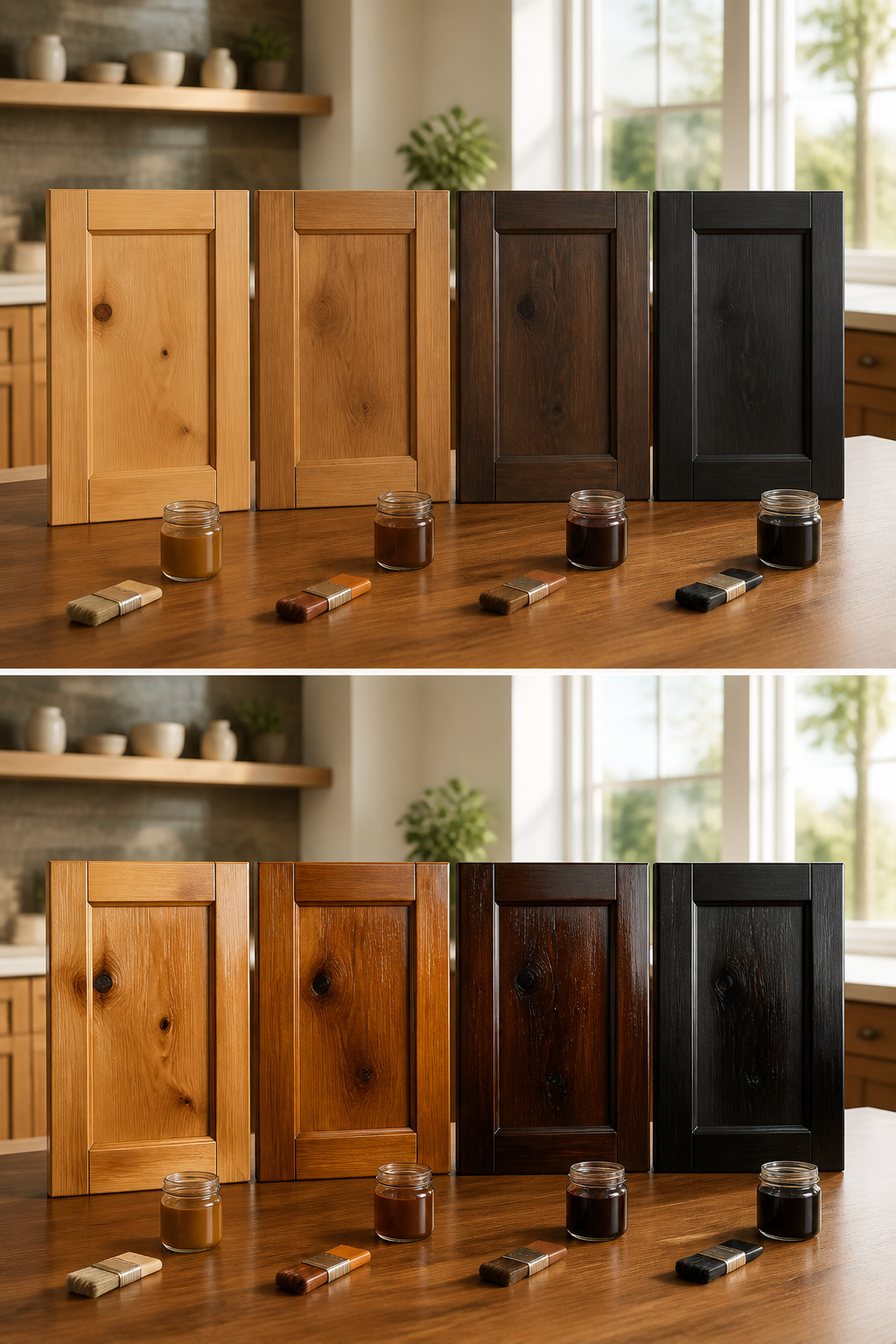
Knotty alder takes stain differently than harder woods, which is both the risk and the reward. The softness that lets it soak up color so warmly also means blotching can catch you off guard if you skip the pre-stain conditioner.
I always test samples on the actual door style I’m ordering, not a generic chip, because the knots and burling read differently under each tone.
Honey and light honey lean into farmhouse warmth without fighting the rustic grain. Espresso and onyx push toward lodge heaviness; the darker pigments actually help even out alder’s natural tone shifts while still letting the knots show through.
For something that reads modern rather than mountain-cabin, driftwood gray sits right in the middle, cool enough for clean countertops but still rooted in the wood’s texture.
One collection runs 14 wood stains and 4 handcrafted finishes on this species, which sounds like overkill until you’re standing in a showroom realizing espresso reads almost purple under certain LEDs.
The handcrafted finishes layer in variation that reads as age rather than flat color, useful when you want the cabinets to feel collected rather than installed last Tuesday.
Matte or satin topcoats suit this wood better than gloss. The low sheen keeps the depth without that plastic-wrap look that high-gloss can give rustic material.
Recommended Products

Pre-stain wood conditioner preps wood for even color

WOOD CONDITIONER FOR STAINING – Ideal for all soft or hard woods, Minwax Pre-Stain Clear Conditioner penetrates the grain of the wood to promote uniform acceptance of water-based wood stains and helps control the effect of grain raising.

Enhance Wood Finish: RustinsPre Wood Conditioner enriches the natural beauty of wood, ensuring a flawless finish
Door Styles
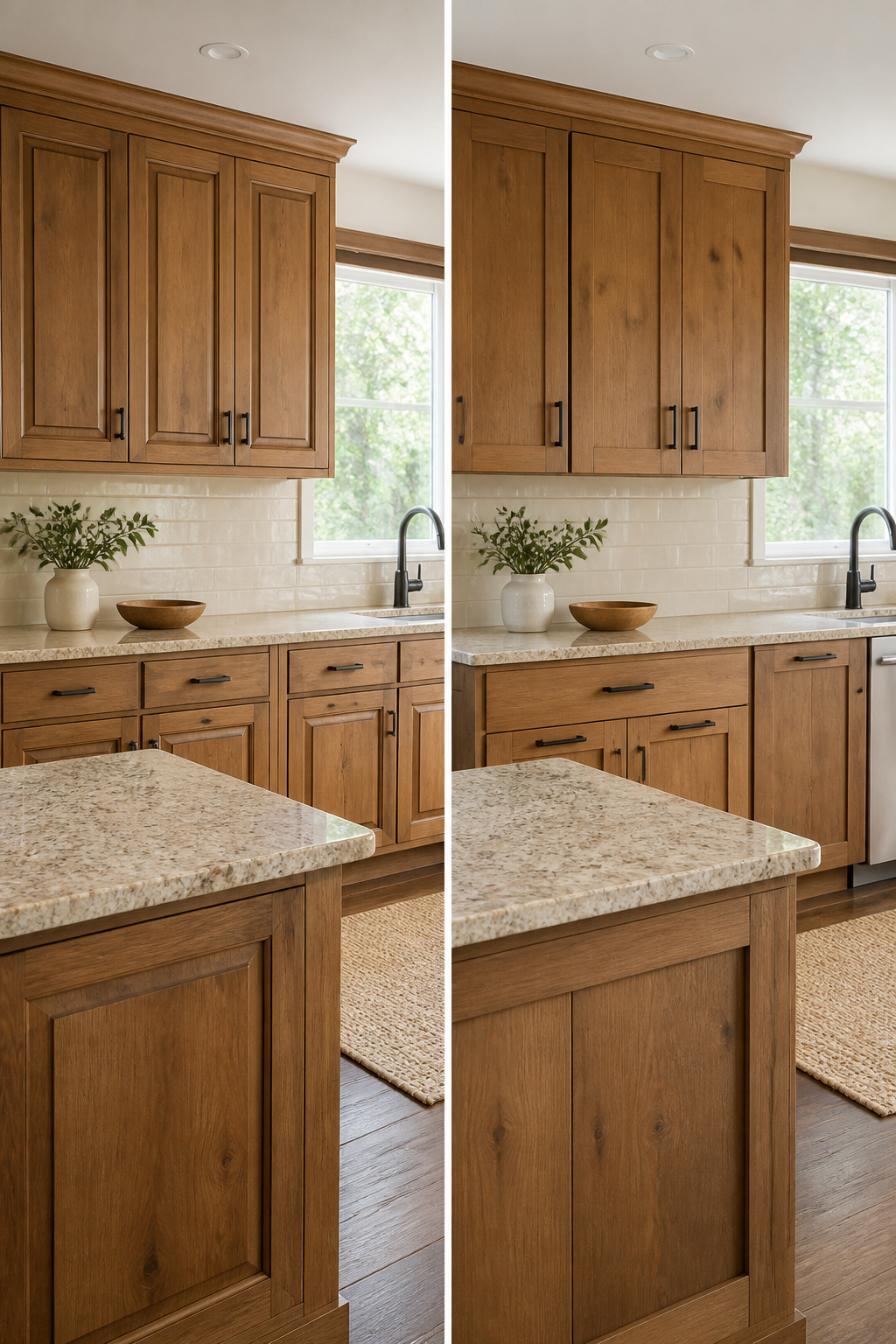
The door style you choose does more to set the kitchen’s personality than almost any other single decision. Knotty alder’s rustic grain reads very differently depending on how the door is built.
Traditional inset doors, where the panel sits flush inside the frame, give knotty alder a quiet, furniture-like presence. The frame itself becomes a visible border, and the knots read as deliberate character rather than roughness.
This is the style that ages best if you want the kitchen to feel settled rather than themed.
Reverse raised panel doors flip the profile so the center field is recessed and the outer frame carries the visual weight.
Two newer styles in this category, Bozeman and Aurora, add a 1/16-inch roundover on the outside edge that softens the silhouette just enough to read contemporary without going full slab-door modern.
The roundover is a small detail, but it stops the frame from looking too heavy against granite’s hard surface.
Slab or flat-panel doors in knotty alder exist, though they fight the material a little. The uniform planes want a cleaner grain, which is where clear alder or a specialty rustic grade with more deliberate distressing becomes the smarter pairing.
If you want that contemporary flat look with warmth, the smoother grain is the more honest choice.
For a kitchen that needs to bridge periods, reverse raised panel in Bozeman or Aurora gives you the most flexibility. The style reads current now, but the wood’s natural variation keeps it from feeling tied to any single year.
Recommended Products

Corner Vanity with compact size of 24 x 24 x 34.5"H makes it perfect for small bathroom spaces
BEVERAGE CENTER FEATURES - The Mont Alpi black stainless steel beverage center comes the outdoor rated MAF refrigerator standard. This modular attachment can be a standalone unit and also comes with the convenience of a built-in stainless steel faucet and 12.25"D x 14.5"W x 8.5"D sink making it a sleek and stylish addition to your outdoor kitchen with a an access door / cabinet right underneath the sink as an extra storage option The beverage center also comes with matching white granite countertop surfaces. Dimensions - 38” x 23” x 35” (countertop) / 38” x 23” x 46” (with faucet)

ISLAND FEATURES - The MAi805-BEV Mont Alpi 805 original series 132" premium outdoor kitchen island with grill arrives almost fully assembled (modular attachment required) and is made from 304 stainless steel. This material blends seamlessly to the white granite countertop surfaces on each side of the 44" stainless steel center grill with storage cabinets directly below. The glass door refrigerator comes standard with this model. You also get large soft closing drawers right underneath your grill for extra storage and easy access, plus a fully covered back with vents. Your outdoor kitchen also comes with gliding castor wheels for smooth and easy-to-maneuver movement and increased stability.
Design Styles
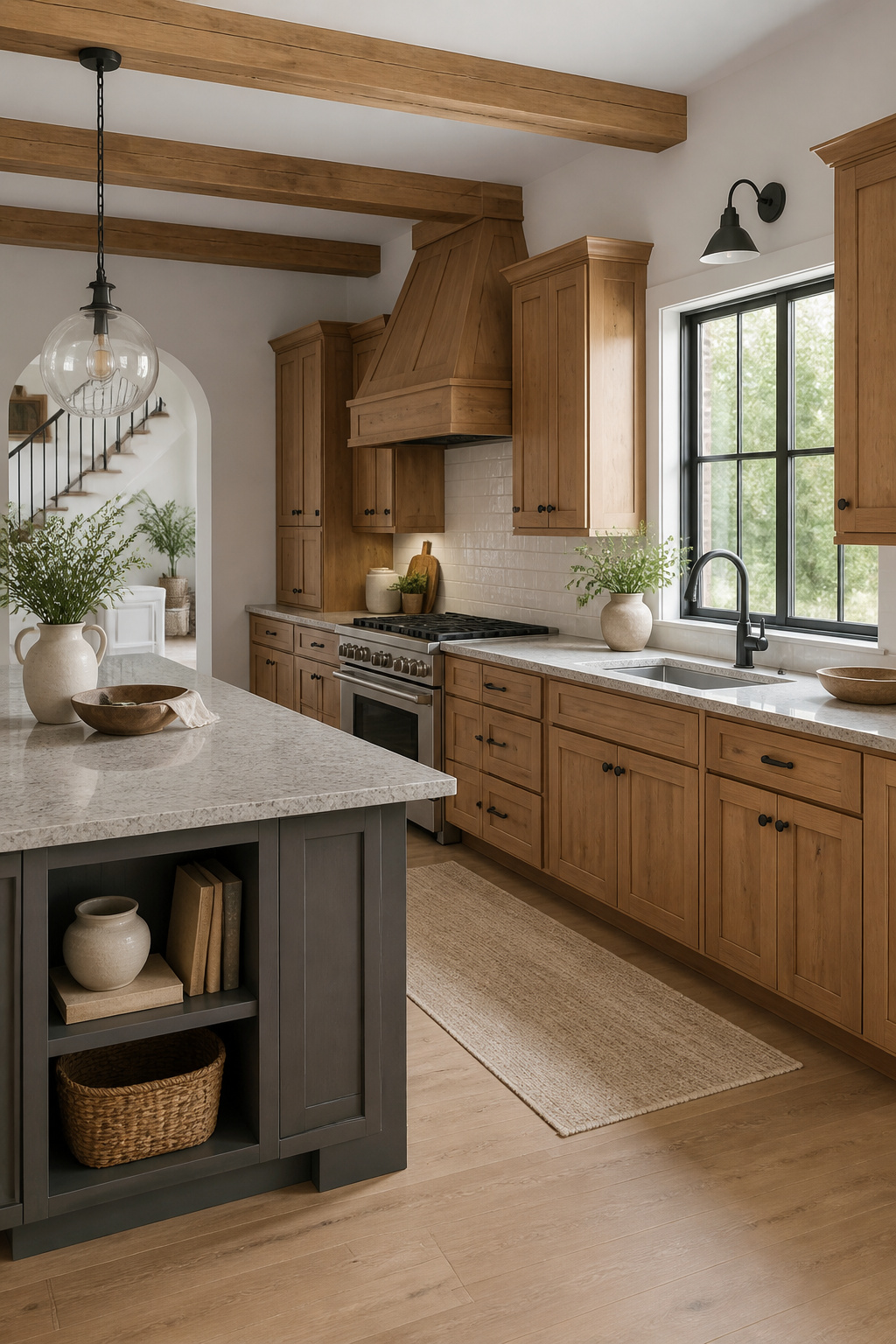
Knotty alder carries enough personality to anchor three distinct kitchens without feeling like the same cabinet in disguise.
In a farmhouse space, the knots read as collected-over-time warmth rather than roughness. A mid-tone stain, something like the Cashew finish with its grey undertones, keeps the look current rather than country-kitsch.
Pair it with a simple shaker door and the granite can do quiet work: a soft grey or cream stone with low movement lets the wood be the story.
The mountain lodge version leans into what the knots want to do naturally. A darker Patina or Hazelnut stain deepens the tone enough that the wood variation evens out while the burling still shows through.
This is where a busier granite, something with veining that picks up the stain color, earns its place. The stone wall in one of the Minnesota builds proves the point: the cabinets hold their own against real texture without competing.
Scandinavian rustic is the discipline test. Light stain, clean door lines, and the knots become punctuation instead of paragraph.
The Highland door style in that same Cashew finish manages this balance; the grey undertone reads as modern while the wood keeps it from feeling sterile. Here the granite wants to be nearly matte, low-sheen, with minimal pattern.
The warmth comes from the alder, not from busy surfaces stacked on busy surfaces.
The stain choice moves the same wood across all three moods. Pick the door style and finish first; the granite follows in about ten minutes of holding samples against the cabinet face.
Recommended Products

Versatile Storage Space: This barn door storage cabinet features a spacious tabletop, perfect for storing cleaning supplies of various heights. It also includes three small storage drawers to help you keep smaller items organized and easily accessible.

Solid hardwood barn door slabs are made in the US with high quality american hardwood

Solid hardwood barn door slabs are made in the US with high quality american hardwood
Pairing with Granite Countertops
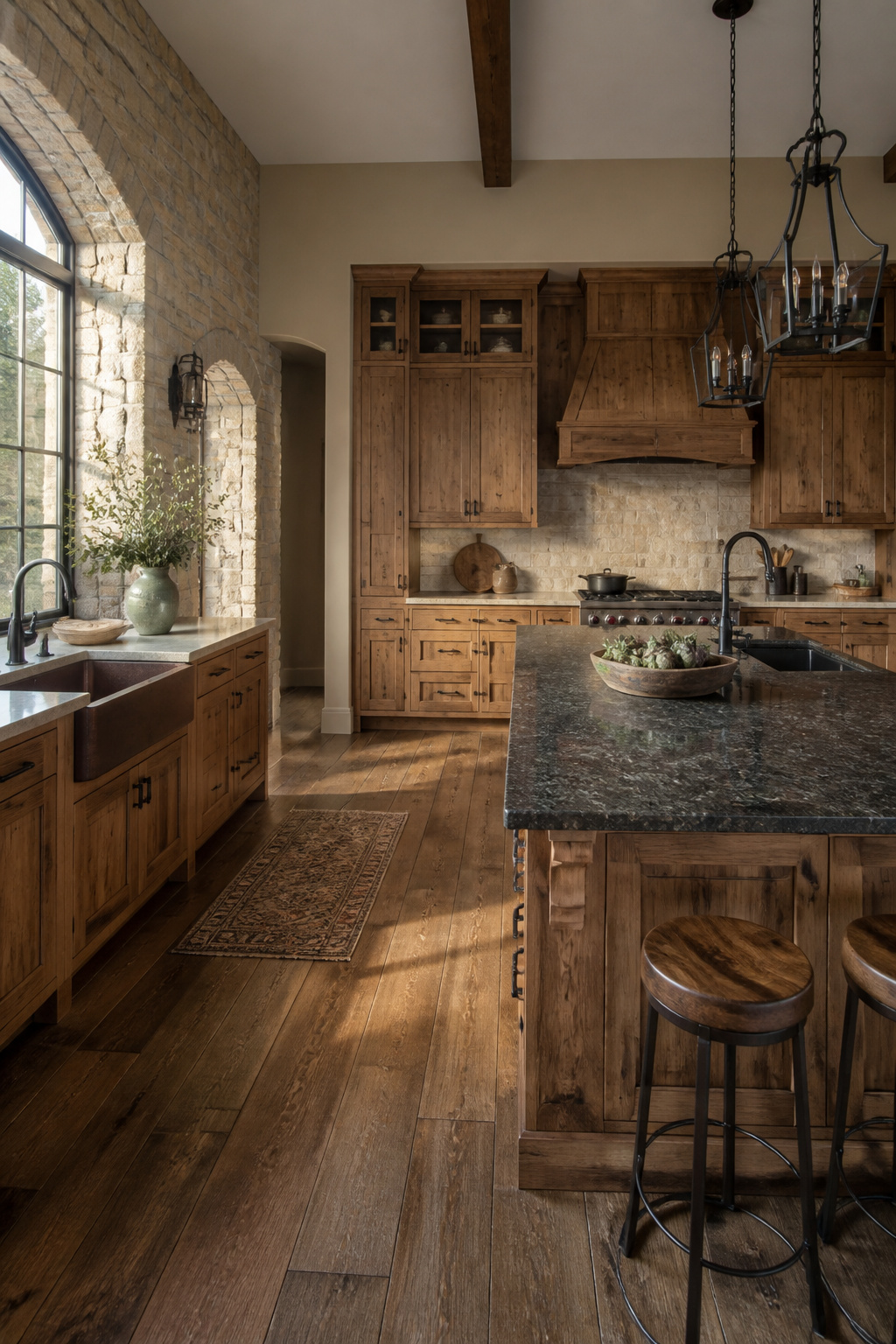
Knotty alder cabinets with granite countertops hit a balance that is hard to fake with other combinations.
The wood brings knots, open grain, and color that shifts from light honey to reddish-brown, while granite adds the density and wear resistance that a kitchen actually needs.
The pairing works because the stone’s cool, solid surface plays against the warmth and irregularity of the wood without competing with it.
Leathered granite, with its low-sheen, tactile finish, seems to be the choice that comes up most often for this look.
That texture reads closer to raw stone than a high-polish slab would, so the rustic thread runs through both materials instead of stopping at the cabinet line.
Iron hardware with hammered detail completes the cabin or farmhouse effect, though that is a decision you can take or leave depending on how far you want the theme to go.
The granite color question is where I ran out of solid ground. Sources agree the pairing works, but none name specific colors, and I will not invent them.
Your best move is to carry a cabinet sample to the stone yard and look for granites that pick up the honey or reddish-brown tones without matching them too closely.
Contrast matters more than coordination here; too close and the two surfaces blur together, too far and they fight. A mid-tone stone with some movement in it usually bridges the gap.
Recommended Products

Complete Package: the package includes 2 unfinished pine kitchen cabinet doors and 4 cabinet hinges, providing you with a convenient set for effortless installation; No need to source additional doors

RECESSED IN WALL (CUT A HOLE IN THE WALL) WITH A 180 DEGREE SWIVEL

MEASUREMENTS: Measurements are EXACT. This replacement raised panel kitchen cabinet door measures 13.25-inches Wide, 29-inches high, and 3/4-inches thick
Maintenance Considerations
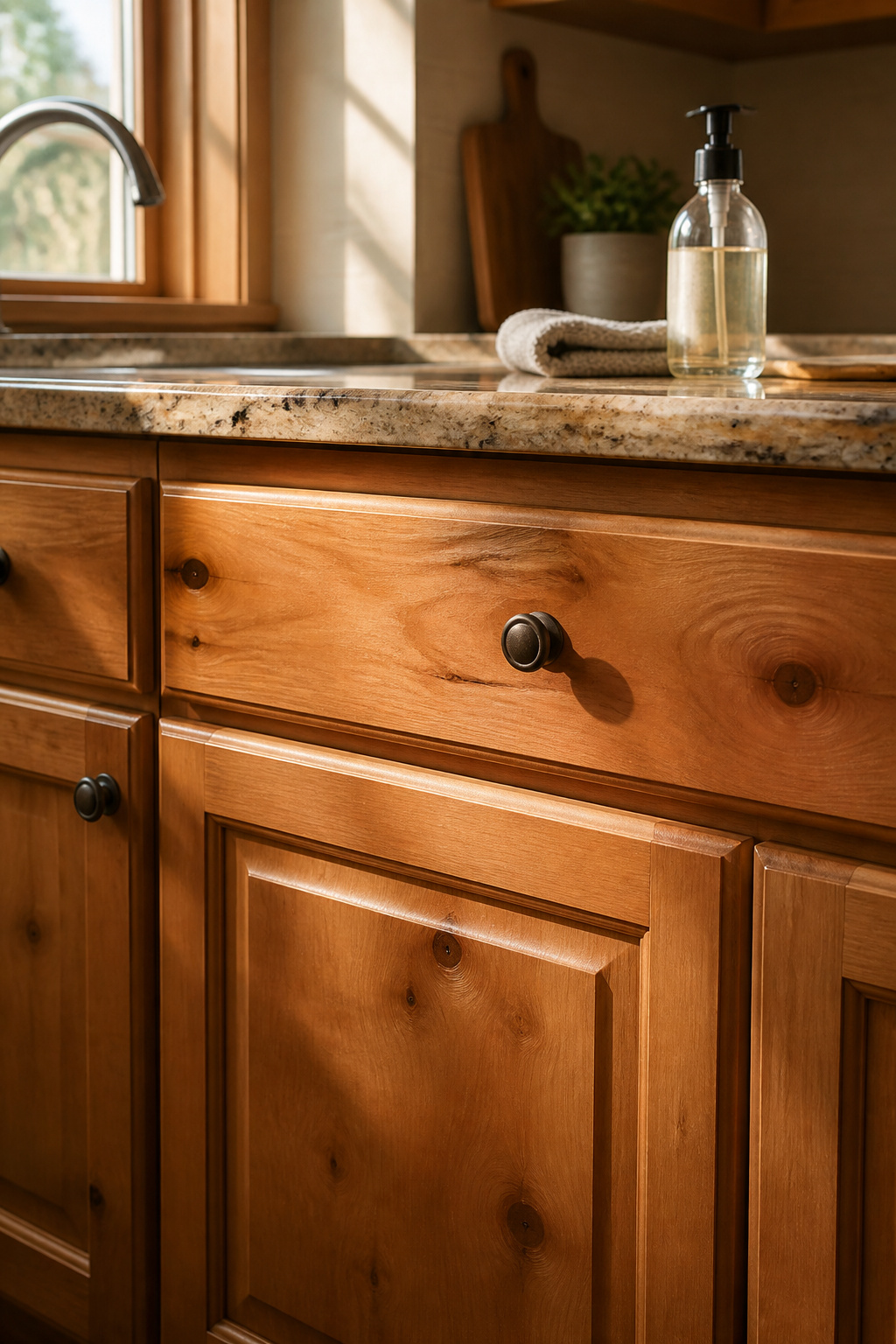
Knotty alder’s softness is the first thing to account for in daily care.
The wood dents and scratches more readily than harder species like maple or hickory, so the finish you choose matters less for preventing damage than for hiding it.
Many homeowners treat these marks as part of the rustic character, but if your kitchen sees heavy traffic, the wear accumulates faster than the patina charm.
Cleaning is straightforward: mild soap and water handle most jobs, and anything harsher risks the finish without improving results.
I have not found specific product recommendations in the usual sources for knotty alder specifically, so keep to the gentlest cleaner that lifts the grime and skip the specialty wood treatments unless your cabinetmaker names one.
The wood also moves with humidity, expanding and contracting enough that inset doors need gap allowance built in from the start.
Once installed, that movement is not something you maintain so much as accommodate: avoid letting steam sit directly on the faces, and do not expect the tight seams you get with stable hardwoods.
Recommended Products

Designed for use before staining new, soft and porous wood surfaces, such as aspen, cherry, birch, poplar or pine with an oil-based stain

Enhance Wood Finish: RustinsPre Wood Conditioner enriches the natural beauty of wood, ensuring a flawless finish.

Solid hardwood barn door slabs are made in the US with high quality american hardwood
Knotty Alder vs. Clear Alder
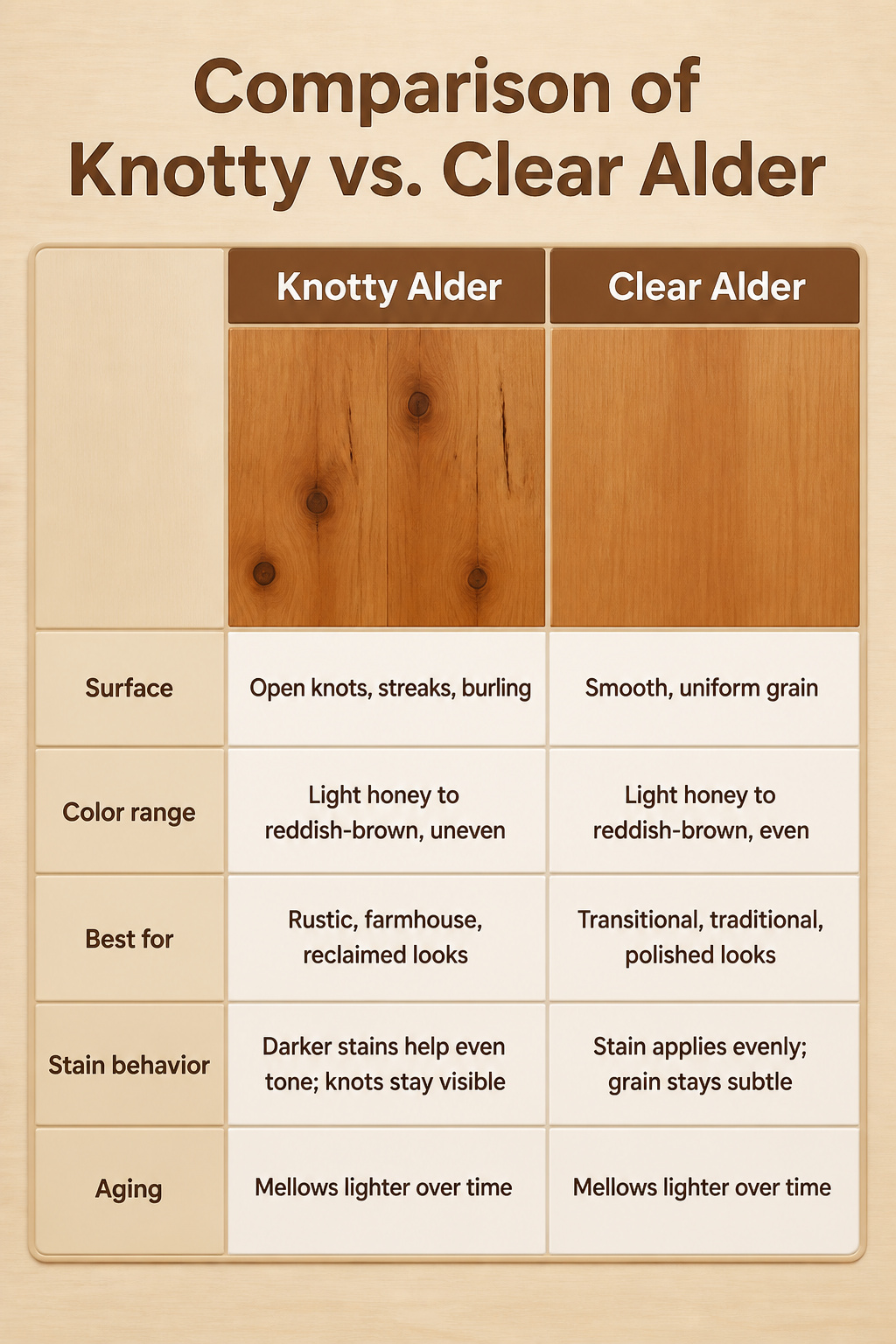
The first time I ordered alder samples, I laid them side by side and the difference hit me immediately.
One board looked like it had lived through something: knots, streaks, color that shifted from honey to reddish-brown across the same plank.
The other was almost too polite, smooth and uniform, the kind of wood that lets a stain do all the talking.
That is the split between knotty and clear alder, and it is not a small one. Knotty alder carries open knots, mineral streaks, and burling that read as rustic and informal.
Clear alder keeps the same straight grain and cherry-like coloring but drops the irregularities for a refined, consistent face.
The choice is really a choice of which problem you want: the visual noise of natural variation, or the risk of a kitchen that feels flat.
| Knotty Alder | Clear Alder | |
|---|---|---|
| Surface | Open knots, streaks, burling | Smooth, uniform grain |
| Color range | Light honey to reddish-brown, uneven | Light honey to reddish-brown, even |
| Best for | Rustic, farmhouse, reclaimed looks | Transitional, traditional, polished looks |
| Stain behavior | Darker stains help even tone; knots stay visible | Stain applies evenly; grain stays subtle |
| Aging | Mellows lighter over time | Mellows lighter over time |
Knotty Alder is a smooth hardwood with a straight grain pattern and coloring similar to Cherry, ranging from a light honey color to a reddish-brown hue. Because of the prevalence of knots, it is appreciated for its rustic, informal appearance.
For a kitchen with granite countertops, that knotty texture can either fight the stone or balance it. A busy granite paired with busy wood looks like two conversations at once.
But a simpler granite, or one with warm undertones that pick up the alder’s honey range, gains character from the knots without tipping into chaos.
Clear alder plays safer, which is not a criticism; it just means the granite does more of the design work.
Recommended Products
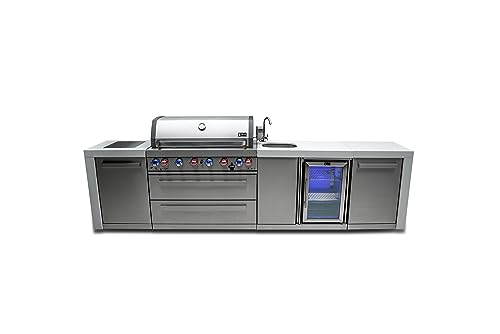
ISLAND FEATURES - The MAi805-DBEV Mont Alpi 805 deluxe series 132" premium outdoor kitchen island with grill arrives almost fully assembled (modular attachment required) and is made from 304 stainless steel. This material blends seamlessly to the white granite countertop surfaces on each side of the 44" stainless steel center grill with storage cabinets directly below. The glass door refrigerator comes standard with this model. You also get large soft closing drawers right underneath your grill for extra storage and easy access, plus a fully covered back with vents. Your outdoor kitchen also comes with gliding castor wheels for smooth and easy-to-maneuver movement and increased stability.

【Dimensions】: This storage cabinet measures 14.5 x 6.5 x 10 inches.

NATURAL WOOD COUNTERTOP CABINET: Crafted with a sturdy wood frame, this cabinet includes 2 magnetic rattan doors and 2 smooth drawers, providing convenient storage for pantry goods, tea bags, medicine, small tools, or everyday essentials in any space
Aging and Color Changes
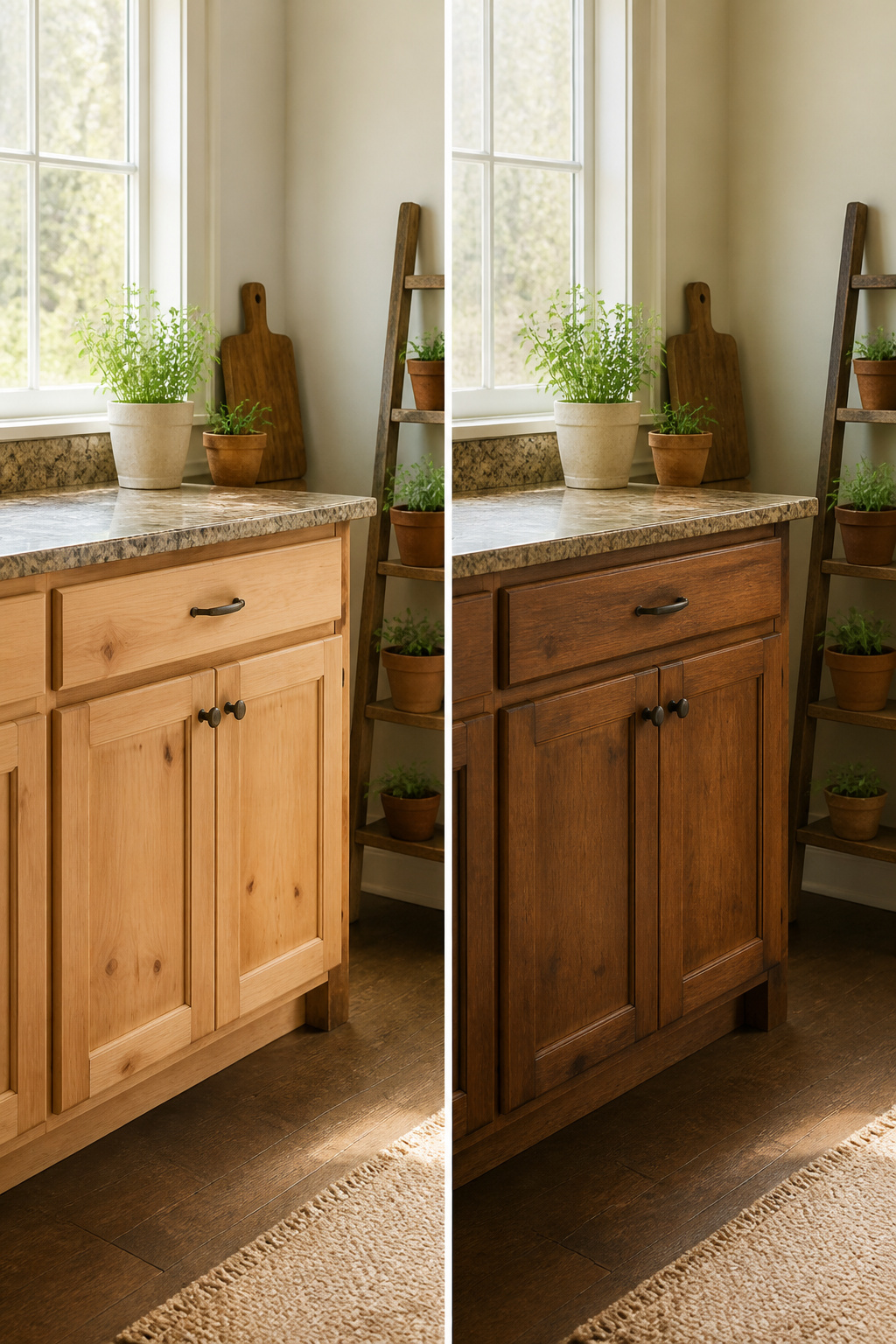
Knotty alder darkens and warms in tone with age and light exposure, a shift that starts within the first year and keeps going gradually.
The knots and burls that give the wood its character also mean the change happens unevenly; lighter sapwood around a tight knot may move faster than the surrounding grain, so the rustic look you paid for actually deepens rather than washing out.
Sunlight drives most of this mellowing.
Upper cabinets near a kitchen window will shift ahead of lower ones in shadow, and a bank of cabinets on a south wall can end up a half-tone warmer than the same stain on the north wall after a few years.
If you are choosing a granite countertop to live with that future color, plan for the warmer version of the cabinet, not the fresh-from-the-showroom one.
A cool gray granite that balances alder on day one can look mismatched once the wood turns honeyed.
The change is not damage. It is the nature of the material, and for most owners it adds to the lived-in warmth that drew them to knotty alder in the first place.
What matters is expecting it, so the kitchen you build and the kitchen you have five years later do not feel like two different rooms.
Hardware Options
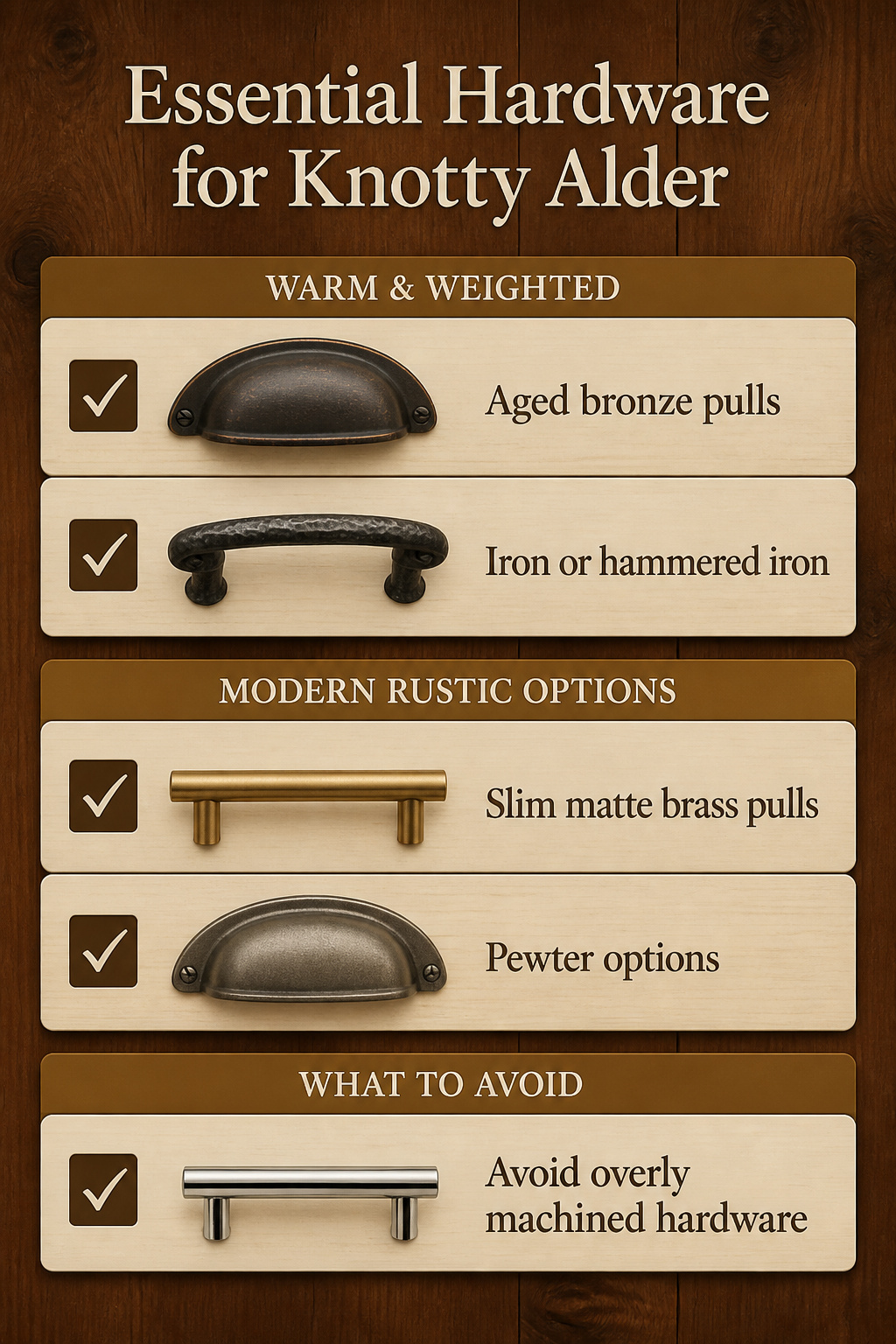
The hardware you choose can either quiet the grain down or let it sing. On knotty alder, three metals tend to get it right.
- Aged bronze or oil-rubbed bronze settles into the door’s warm honey or chestnut stain without fighting it. The darkness picks up the knots and makes the whole run of cabinets feel like a single piece of old furniture. This is the pairing to use if you want farmhouse weight rather than contrast.
- Iron or hammered iron brings a lodge heaviness that alder’s soft tone needs. The slight unevenness in hand-forged pulls repeats the irregularity of the knots. In my reading, this is where most people stop and stay happy.
- Brass works, but only in a narrow range. Slim matte brass pulls read rustic-modern; bright or polished brass reads kitchen from 1987. Pewter can substitute if you want the same low shine with a cooler undertone, as some grey-tile installs do.
Skip anything too perfectly machined. Knotty alder already carries the story of handwork; hardware that looks stamped from a single die feels like a correction rather than a completion.
Recommended Products

High-Quality Material: Constructed with engineered wood for durability

Precision Measurement: Ensure that the 11W x 18H dimensions match your existing cabinet openings to avoid fitting issues

Custom-Sized Precision: Custom-sized to your exact dimensions down to the nearest 1/16", our cabinet doors ensure seamless installation without gaps or misalignment. Update your kitchen or bathroom with precision-built doors made just for your space
Cost Considerations
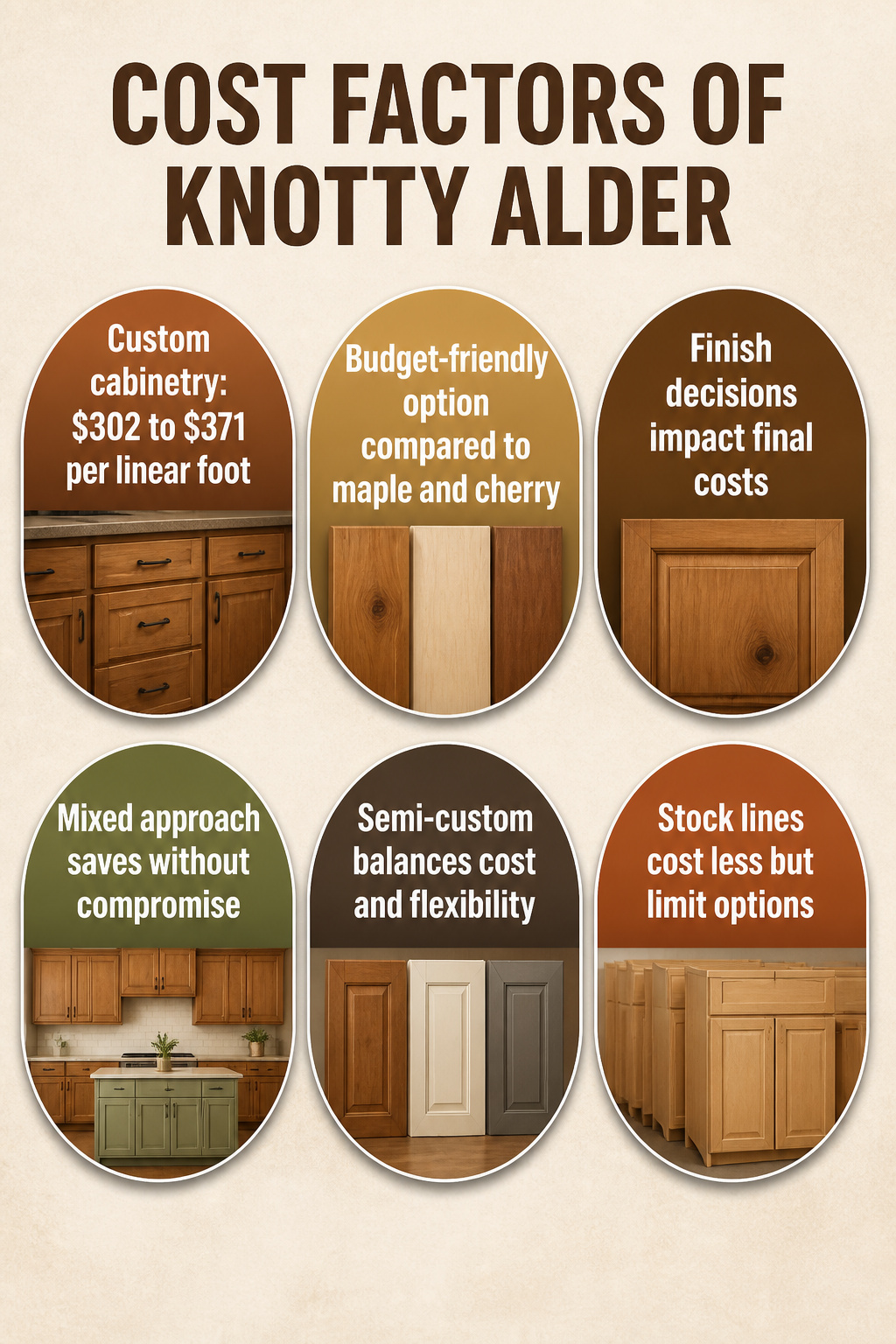
Knotty alder sits comfortably below maple and cherry on the price ladder, which is why it shows up so often in kitchens where the budget has to cover both cabinets and stone.
The gap matters more than people expect: once you price the run of base and wall cabinets for a medium kitchen, choosing alder over a premium hardwood can free up the difference for a level-granite upgrade or a better sink package.
Custom alder cabinetry runs $302 to $371 per linear foot, though that band widens quickly depending on how far you push the finish and the joinery. A hand-rubbed glaze adds labor; a painted island in a complementary color subtracts it.
That mixed approach, rustic alder on the perimeter with a painted island, keeps the warm wood where you see it most and trims the total without looking like a compromise.
Stock lines cost less but lock you into standard sizes and fewer door profiles; semi-custom splits the difference if your kitchen layout is straightforward. The finish decision usually drives the final number more than the wood itself.
Recommended Products

PRE-STAIN TREATMENT FOR ALL WOOD – Ensure wood projects look great with Minwax Pre-Stain Wood Conditioner. Use prior to applying oil-based wood stains to help prevent...
Frequently Asked Questions
What is the difference between alder and rustic alder?
u003cpu003eStandard alder has a smooth, uniform appearance, while rustic alder includes knots, burls, and natural color variation that create a more rugged, character-filled look. Knotty alder specifically highlights open knots, mineral streaks, and varied grain.u003c/pu003e u003cpu003eThe rustic version is what most people picture when they think of farmhouse or lodge-style cabinets.u003c/pu003e
Are alder cabinets good quality?
u003cpu003eYes. Alder is a stable hardwood that holds up well for cabinetry when finished properly.u003c/pu003e u003cpu003eIts softness, rated at 590 on the Janka hardness scale, makes it easier to dent than maple or oak, but that same quality allows it to take stain evenly and keeps fabrication costs manageable.u003c/pu003e u003cpu003eMany homeowners treat the accumulated marks as part of the wood’s rustic character.u003c/pu003e
Should I get knotty alder or clear alder?
u003cpu003eChoose knotty alder if you want a rustic, natural look with knots and variation; clear alder works better if you prefer a smoother, more refined appearance.u003c/pu003e u003cpu003eKnotty alder carries open knots, mineral streaks, and burling that read as informal and collected-over-time, while clear alder drops those irregularities for a consistent, polished face.u003c/pu003e u003cpu003eWith granite countertops, knotty alder balances best against simpler stones, whereas clear alder lets the granite do more of the design work.u003c/pu003e
Do alder cabinets yellow over time?
u003cpu003eAlder darkens and warms in tone with age and light exposure rather than yellowing, starting within the first year and continuing gradually. Sunlight drives most of this mellowing; upper cabinets near windows shift ahead of lower ones in shadow.u003c/pu003e u003cpu003eThe change is not damage but the nature of the material, and it adds to the lived-in warmth that draws people to knotty alder in the first place.u003c/pu003e